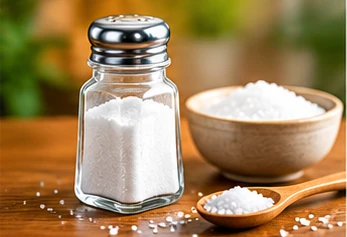
Sodium & Salt
Sodium and salt are closely related, but they are not the same thing.
Sodium is an essential mineral. Table salt is sodium chloride (NaCl), a compound made from sodium and chlorine.
Food labels measure sodium because sodium can come from table salt as well as from many other sodium-containing ingredients.
What Is Sodium?
Sodium is a mineral — a chemical element that the body needs in relatively small amounts. It participates in several normal body functions, including helping maintain fluid and electrolyte balance and supporting normal nerve and muscle function.
Sodium occurs naturally in some foods and can also be added to foods during production and processing.
Sodium and salt are not interchangeable words. Salt is a compound that contains sodium, but not all sodium in food comes from table salt.
What Is Salt?
Ordinary table salt is sodium chloride, written chemically as NaCl. It is a compound made from sodium and chlorine — two elements that are individually reactive but form a stable, familiar solid when combined.
When sodium chloride dissolves in water — as it does in the body — sodium and chloride separate into ions. In this form they can be absorbed and used by the body.
Table salt is approximately 40% sodium by mass. This proportion is the basis for the standard conversion between salt and sodium content.
Salt and Sodium: The Math
When the amount of actual sodium chloride is known, its sodium content can be estimated using the WHO conversion:
Source: World Health Organization
This is one reason Nutrition Facts labels report total sodium rather than only the amount of table salt added.
Sodium Isn’t Just Table Salt
Sodium can come from many different compounds and ingredients found in processed and packaged foods. Examples of sodium-containing food ingredients include:
- Monosodium glutamate (MSG) — a flavor enhancer
- Sodium bicarbonate — a leavening agent (baking soda)
- Sodium nitrate and sodium nitrite — used in curing
- Sodium benzoate — a preservative
- Sodium phosphate — used in processing and texture
Because sodium appears in so many forms, the FDA requires that Nutrition Facts labels report total sodium — not just the sodium from table salt.
What the Nutrition Facts Label Tells You
On a U.S. Nutrition Facts label, sodium is listed in milligrams (mg) for one serving. Two values appear:
- Milligrams (mg) — the absolute amount of sodium in that serving
- % Daily Value (%DV) — the sodium in that serving as a percentage of the FDA Daily Value of 2,300 mg for adults
The serving size listed on the label matters. If a label shows 400 mg of sodium per serving and you eat two servings, you consume 800 mg — twice the listed amount.
My Sodium Today works with both representations — sodium in mg and as a percentage of the FDA Daily Value for adults. These are two ways of expressing the same sodium amount. You can enter either one in the meal-entry form and the other updates automatically.
Does All Salt Taste Salty?
Sodium can be present in a food even when it does not taste particularly salty. Sodium-containing ingredients can serve purposes well beyond simply adding salty flavor. In food production, sodium compounds may be used for:
- Preservation — extending shelf life
- Curing — treating and preserving meats
- Baking — sodium bicarbonate produces carbon dioxide for leavening
- Texture — affecting the structure of certain foods
- Moisture retention — helping foods stay moist
- Flavor enhancement — amplifying or balancing other flavors
Reading the Nutrition Facts label is a more reliable way to understand a food’s sodium content than relying on taste alone.
Sea Salt, Kosher Salt, Himalayan Salt and Other Salts
Salts sold under names such as sea salt, kosher salt, Himalayan pink salt, and similar labels can differ from ordinary table salt in crystal size, texture, processing method and the presence of small amounts of other minerals. They are still sources of sodium. The primary component of these salts remains sodium chloride.
When a food label lists sodium content in mg or %DV, that figure accounts for the actual sodium in the product regardless of which type of salt was used.
Where Does the Sodium We Eat Come From?
Much of the sodium in the typical diet does not come from salt added at the table or during home cooking. The FDA states that more than 70% of dietary sodium in the United States comes from packaged and prepared foods. The CDC and AHA similarly identify processed, packaged, prepared and restaurant foods as major contributors to dietary sodium intake.
Because sodium is added at the production and processing stage, reading Nutrition Facts labels is one of the most practical ways to understand how much sodium a food contains before eating it.
What Happens to Salt After We Eat It?
Salt does not simply pass through the body unchanged. When sodium chloride dissolves — in food, in the digestive tract, or in body fluids — it separates into sodium ions and chloride ions. The body absorbs both, then actively regulates how much it retains and how much it excretes. The kidneys play the central role in this regulation, adjusting sodium excretion in response to the body’s needs and what has been consumed.
Much of the sodium and chloride we consume is eventually excreted from the body through urine, with smaller amounts lost through sweat and other routes. The National Academies of Sciences, Engineering, and Medicine notes that the kidneys are highly capable of adjusting sodium excretion across a wide range of intakes in healthy individuals.
The sodium and chlorine atoms themselves are not destroyed in this process. Their chemical form can change as they move through the body and environment — but the elements continue as part of the continuous flow of minerals through the natural world.
Salt on Earth: A Much Bigger Cycle
Earth contains enormous quantities of dissolved salts, particularly in the oceans. The U.S. Geological Survey (USGS) estimates that if all the salt in the oceans were spread over dry land, it would form a layer more than 500 feet thick. The oceans are the planet’s largest reservoir of dissolved sodium and chloride.
Over geological time, weathering breaks down rocks and minerals. Rainwater and rivers carry dissolved ions — including sodium and chloride — toward the sea. Hydrothermal vents on the ocean floor and volcanic activity also contribute ions to seawater. The USGS describes this as an ongoing geological process that has operated for billions of years.
Salt can also be deposited and buried. When ancient seas evaporated, thick layers of salt were left behind and later covered by sediment. These underground deposits — mined today as rock salt and halite — are the remnants of earlier geological eras. Salt mines and deposits can be depleted over time.
Sodium Recommendations Are Not All the Same
Major health and scientific authorities each publish their own sodium reference values. These are not identical in purpose or in amount.
| Authority | Reference |
|---|---|
| FDA | 2,300 mg sodium — Daily Value for adults |
| CDC | Less than 2,300 mg/day for teens and adults |
| AHA | No more than 2,300 mg/day; an optimal goal of no more than 1,500 mg/day for most adults |
| WHO | Less than 2,000 mg/day (equivalent to 5 g salt) |
| EFSA | 2,000 mg/day — safe and adequate intake for the general EU adult population |
These reference values are not interchangeable. They come from different organizations with different methodologies and purposes.
My Sodium Today uses the FDA Daily Value of 2,300 mg as its primary tracking reference — the same value used on U.S. Nutrition Facts labels. See References and Health Information for more detail on each authority’s position.
Bottom Line
Sodium and salt are closely related, but they are not the same thing. Table salt is sodium chloride, while sodium is the mineral measured on food labels. Sodium can come from many sources, and the amount of sodium in a known quantity of salt can be calculated. Sodium and chloride are absorbed, regulated and eventually eliminated from the body, while the atoms themselves continue through the larger natural cycles of Earth.
Sources
- U.S. Food and Drug Administration (FDA) — Nutrition Facts label, sodium and %DV guidance
- Centers for Disease Control and Prevention (CDC) — dietary sodium sources
- National Institute of Diabetes and Digestive and Kidney Diseases (NIDDK) — kidney and sodium regulation
- American Heart Association (AHA) — dietary sodium and food sources
- World Health Organization (WHO) — sodium and salt recommendations, salt-to-sodium conversion
- European Food Safety Authority (EFSA) — sodium adequate intake for adults
- U.S. Geological Survey (USGS) — oceanic salt quantities and geological cycling
- National Academies of Sciences, Engineering, and Medicine — dietary reference intakes for sodium and chloride, kidney regulation
See References for the specific documents and links.